
What if the donors you seek are already here?
If you run a nonprofit or a mission-based for-profit organization, it's worth thinking about who might already have loyalty to you when you're looking for new donors.
Read More
September 9, 2026
Report

I overheard that about a week ago. I believe it. We ignore these tools at our own peril. I encourage everyone to use them in your daily work as marketers - but with a few key considerations, which we'll explore in this edition.
- Tim Yeadon, Principal & Lifecycle Strategist
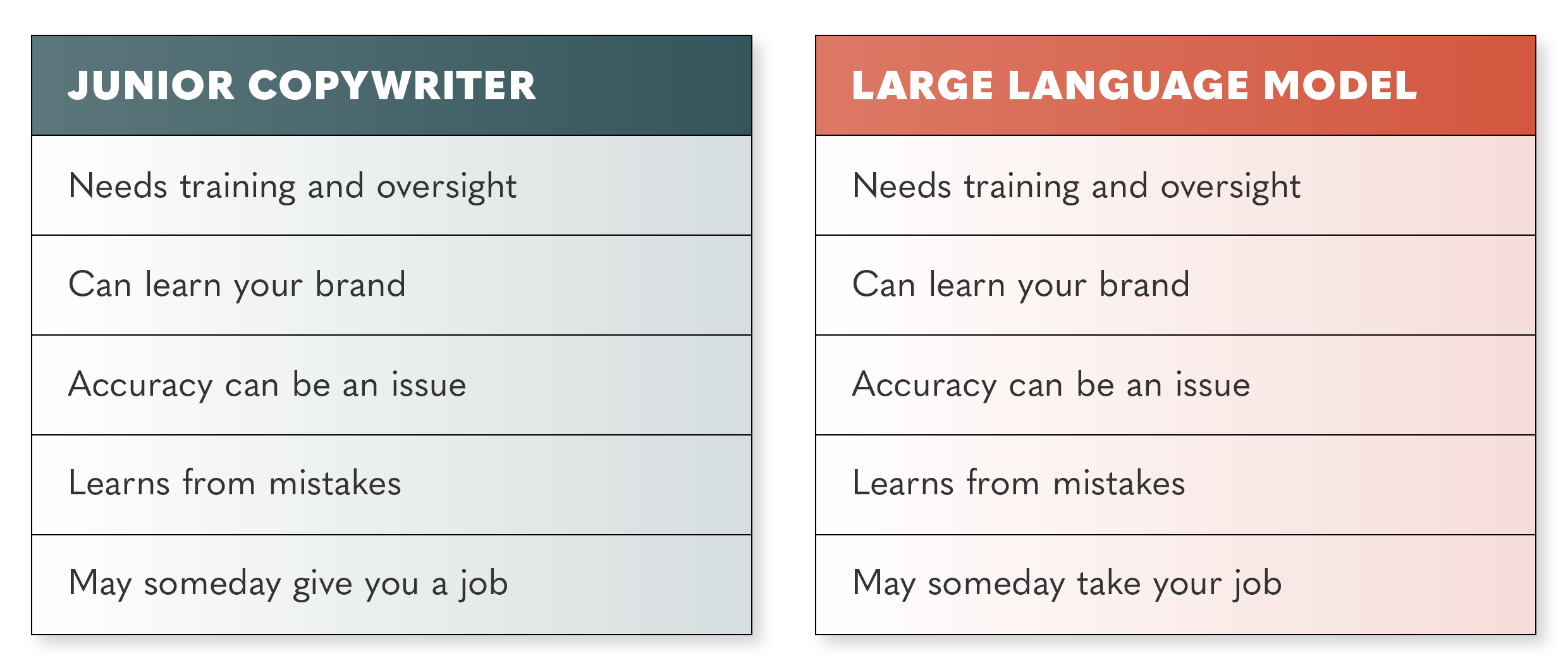
In my experience, ChatGPT or any of the other AI tools can’t create anything you can send directly to your audience. But then, neither can most junior copywriters. In fact, they're both going to need a lot of direction.
Like a fledgling copywriter, AI can get you 75% of the way to a sendable message. The tool might create a plausible first draft, but might not know when to apply the best practices of your particular channel.
I know that I needed a lot of editing when I started off as a marketing copywriter. This was 2005. I’d already been a newspaper reporter. I was a solid writer. But I did not understand the rules of writing for marketing audiences. My various creative directors edited me thoroughly, taught me best practices, and it didn’t take long before I was an effective communicator across a number of channels. Email, web, video, app, display - each had their own peculiarities, and continue to do so.
Looking ahead, the consulting agency Gartner predicts that by 2025, 30% of outbound marketing messages from large organizations will be synthetically generated, up from less than 2% in 2022.
Being that they are here to help us (I hope), here’s a few key considerations when generating synthetic marketing messages with an AI tool.
Accuracy in messaging is your responsibility. It’s up to you to monitor what a large language model churns out on your behalf.
If you’re going to send out anything to your audience under your brand name, ask yourself:
Many of the issues faced by AI systems today are caused by “bias-infused data” used to train these models. This is bias baked directly into the algorithms that inform and drive AI programs.
But in its most basic form, AI is just a tool that watches for external signals and then delivers a response. So who decides which signals are sought, and which responses are deemed appropriate? This matters.
Not coincidentally, this is yet another great argument for the value of having diverse voices in your organization.
1 Source: Generative AI, Gartner.
In Indianapolis, only a non-local would say anything other than “Indy.” (Or so I’ve been told by people from Indy. I’ll have to take their word for it. I’m from Washington State.)
Ever drive through Los Angeles on “The Five” but then find yourself on “I-5” when passing through Portland or Seattle? It’s the same road. But the vernacular changes regionally.
Many years ago, when I lived in North Carolina I was once corrected when I exclaimed, “Hey, a firefly!” (“Huh? That’s a lightnin’ bug, son, and where you from, anyways?") These are among the many reasons you can’t take synthetically generated copy and send it straight out to your audience segments.
It’s because AI isn’t from around here, and people can spot an outsider from afar. When speaking to local or regional audiences versus national audiences, you need to respect local nuance if you want to be trusted.
Over time, people have likely come to expect a specific brand voice from your organization. Perhaps it’s playful, or maybe it’s serious and direct. (“Chatty” is another favorite. "Dour" perhaps less so.)
In my experience, initial output from an AI tool can feel flat, or unpredictable. Once again, you can’t just take what you’re given and send it directly to your audience. You’ll need to filter it through any brand compliance guidelines that you might have developed.
However, if you want to test new tones within your brand voice - it’s here where AI tools can really shine.
To me, your brand voice is composed of the various tones that you have chosen to express along the customer journey. (Your voice, in essence, is the sum of your tones, much in the same way that people’s perception of you personally is formed by the various interactions they have with you.)
I often use AI tools to get a tone or “emotion” assessment of messages that I’m considering testing. Here’s an example.
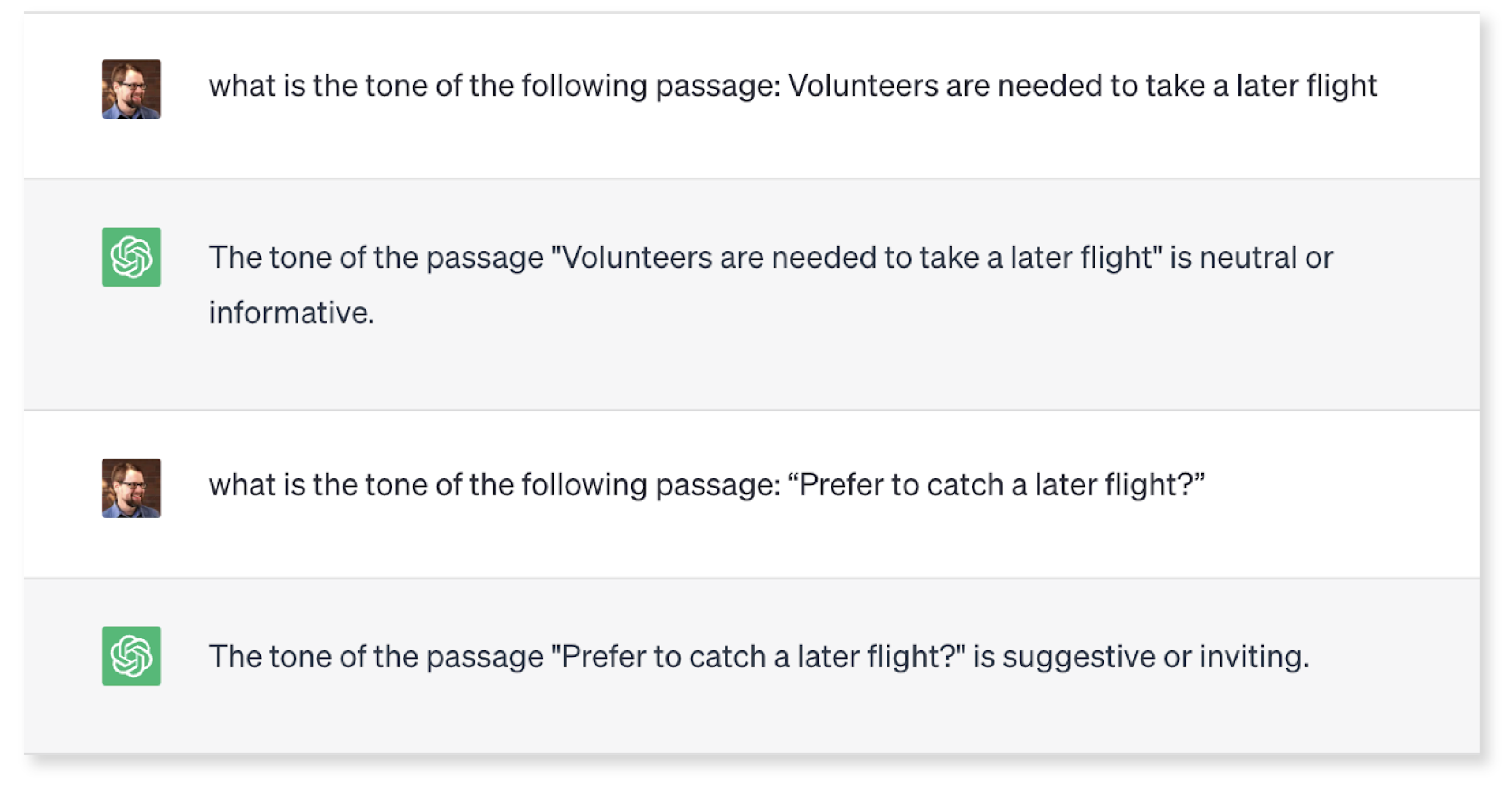
You can learn more about tone testing in this video.
In recent years, I’ve also heard anecdotes from other marketers that describe how the use of various AI messaging testing companies helped achieve massive engagement lifts across easily tested elements like subject lines, but it accomplished this by using any means necessary.
(For instance, using “Urgency / ALL CAPS” when a brand generally sticks to “Expert / Calming.” You can get the open, but then it creates an unrealistic expectation for the reader.)
Long term customer relationships benefit companies more than short term gains, and you're more likely to build these relationships by being true to your own brand voice.
I recommend taking any and all AI generated content and adapting it to your brand voice prior to sending it to your audience. Or getting better at the next topic - prompt engineering.
AI and large language models such as ChatGPT, or Perplexity (or whatever your favorite AI flavor of the month happens to be) that help generate synthetic messages are simply tools that will help us scale. It's your job to learn how to prompt great responses.
Moving forward, the ability to write a strategic "brief" to prompt a useful response out of tools like ChatGPT appears to be the real skill you'll need in the near future.
These tools need direction. They don't know anything about your audience, your channel, your best practices, legal concerns, or anything about your brand. It has no feelings or gut instinct, either. And anything it spits out must be validated.
It’s the same skill if you’re a strategist, or something who needs to write a technical brief for your dev or team, or a creative brief for copywriters and designers.
Good briefs are valuable because of the thinking and inputs going into it, not because of the artifact itself. AI may be a great tool to help a product manager or strategist refine the language and structure of a brief, but I'd be extremely skeptical of a strategy created by a large language model.
So, the better you get at articulating your needs, audience, and other mandatory items, the more likely you will be to receive great results.
It’s not that different from working with a junior copywriter.

Converted: The Data-Driven Way to Win Customers’ Hearts. Irecently read this book by Neil Hoyne, Chief Strategist at Google. According to Hoyne, the top companies are shifting from simply sending quick messages that ask for an immediate response (CTA) to engaging in deeper, long-term conversations with their customers. He emphasizes the importance of identifying your customers and predicting their "Customer Lifetime Value" (CLV).
From there, it's about deciding who you want to build a deeper and long-lasting relationship with. Is it the customer segment that makes up 80% of your revenue, or the smaller 20%? It sounds obvious but learning how to develop an effective program requires skill. “Don’t treat anybody equally. Be deliberate and precise in whom you target and how. Don’t slam the door on any of your customers. But don’t break out the good whiskey for all of them, either.”

How Do We Anchor Content Marketing Efforts in a Multi-Platform Distribution World? Recently, I’ve wrestled with this question while working on top of funnel digital marketing programs. Rand Fishkin of Sparktoro not only made me “feel seen” but also reminded me of the importance of reach and resonance when creating content. And it’s ok if not every piece of content can be traced back to a conversion metric. It’s still helping you hone your messaging and learn what’s effective.

What is a Cinemagraph? I recently went down a rabbit hole of articles like this one by Christopher Bryan-Smith, after first hearing about cinemagraphs via Email Love's recent blog on the same subject. A cinemagraph is essentially a still image with a few moving elements added. (For example, envision an image of a house by a lake; nothing in the image is moving except ripples on the water). Somewhere between a photo and a video, cinemagraphs can also be exported as GIFs. As Andy points out, they can add a unique and memorable touch to your email designs. I’m inspired to try this technique out!

Coast Salish Place Names of the San Juan Islands. I love this “Story Map”. It’s an effective use of GIS Data to share knowledge and drive awareness around efforts to sustain the Samish Language. “Many maps add our indigenous names as an afterthought,” explains the Samish Indian Nation on their website. “The goal of the map… is to flip the narrative to prioritize our relationship and history with this territory that have been here since time immemorial over the contemporary names that have been normalized only relatively recently by today’s broader society."
How are you using AI with your marketing teams? What are your wins? What are your challenges? Hit reply and let us know. (Or just say hi. We'd love to hear from you.)
MXGolden is a service offering of Clyde Golden, the member retention marketing agency for nonprofits and mission-based organizations.
Anacortes, WA

