
What if the donors you seek are already here?
If you run a nonprofit or a mission-based for-profit organization, it's worth thinking about who might already have loyalty to you when you're looking for new donors.
Read More
October 7, 2026
Report


Written by Tim Yeadon
I can't stand it when I'm checking out at the grocery store and the cashier uses my name.
"Thanks, Tim."
Hearing my name from a stranger always surprises me. Everyone standing in line just learned my name, too. I can suddenly feel their eyes. I cringe and clench my jaw.
Thanks, I mutter, trying to look like I'm smiling. Have a great one.
To be fair, I can't blame the cashier for my personal issues. They're just doing what the company trained them to do.
These bumpy little interactions got me thinking about something we talk about in marketing all the time: the importance of personalization in our communications with people.
We know so much about them. But I think what people really prefer is relevance. Better yet, they want to know we've been listening. That we've been paying attention. That we know what they care about, need, or seek help with.
Using someone's name at the top of a marketing or fundraising email, or while you're standing in line at the store, isn't nearly as effective as knowing that you don't buy meat, that you're a fledgling runner with high arches, or that you gave a donation last year because you, a duck hunter, felt a deep connection to a specific wetland that was protected from development.
Using my name doesn't make me feel known. It just tells me the computer connected my loyalty account to my purchase. That's what I call shallow personalization. (It's often not even my real phone number, by the way. I've been using my dad's phone number for decades. I'm sure he enjoys all those points.)
Relevance comes from behavior and interests, not demographics. They're clues about what matters to us and what we might need next.
Personalization says, "Hi, Tim."
Content relevance says, "We've been paying attention and have a good sense of what you're actually interested in."
It's a difference worth considering.
You might think about your own organization and how this might apply.
Knowing I volunteer at an organization but have never given a donation (even though I've been asked for years), so instead you ask me to mentor a new member? That's paying attention.
What if you see that a new member of your organization hasn't attended a class in six weeks? Maybe you send them a "We've missed you" message with a beginner class recommendation. That's relevant based on their behavior. (Or it's at least worth testing).
Years ago, I worked for a summer behind the deli counter at a Safeway on the top of Queen Anne Hill in Seattle. This was long before loyalty programs were tied to your phone number. Unless someone introduced themselves, we had no idea what their name was.
After a few months on the job, I knew a lot of the regulars. I knew who probably wanted potato salad, who generally liked their ham sliced paper-thin, and who preferred that their sandwich was made quickly and without much conversation. A lot of customers would recognize me, nod, and we'd say our hellos. I didn't know their names, but I knew what they liked. That's relevance.
Marketing databases are full of facts about us. Here are a few about me.
First name: Tim. Male. Age: 53. Used to live in Seattle, now lives in Anacortes. Shoe size: 10.
All perfectly fine attributes. Other than my shoe size, you could probably figure all that out with a slightly creepy, yet free internet search. But there are a lot of Gen X guys like me in Washington. Beards and glasses are the norm. It's fair to guess that we own a lot of denim and hoodies, too.
But I'm not sure that really tells you who I am, what I believe, or how I long to spend my time. And I doubt those same attributes will fully describe you either.
People are complex. It's well known that we say one thing and do another. It's not even done in a nefarious way. It's just how we are.
Finding out what's relevant to me is far more useful. You don't even have to ask. Just watch my behavior. Keep an eye on how recently I've done these things, how often, and how much money I've spent along the way.
In marketing, one method to track behavior is via an "RFM strategy," in which you segment people into groups based on:
Stack those three together and you get a clear picture of someone's enegagement with your organization. Not who they say they are. Who they actually are, based on what they do.
For instance, the person who buys every week and spends real money? They aren't the same as the person who bought once, two years ago, during a sale. Treat them the same and you'll lose the first person and waste your time on the second. You can do the same for members of your association or donors.
It's another strategy among many in staying relevant to your people. All you have to do is pay attention.
The author, Tim Yeadon, is Principal of Clyde Golden, the member retention marketing agency for nonprofits and mission-based organizations.
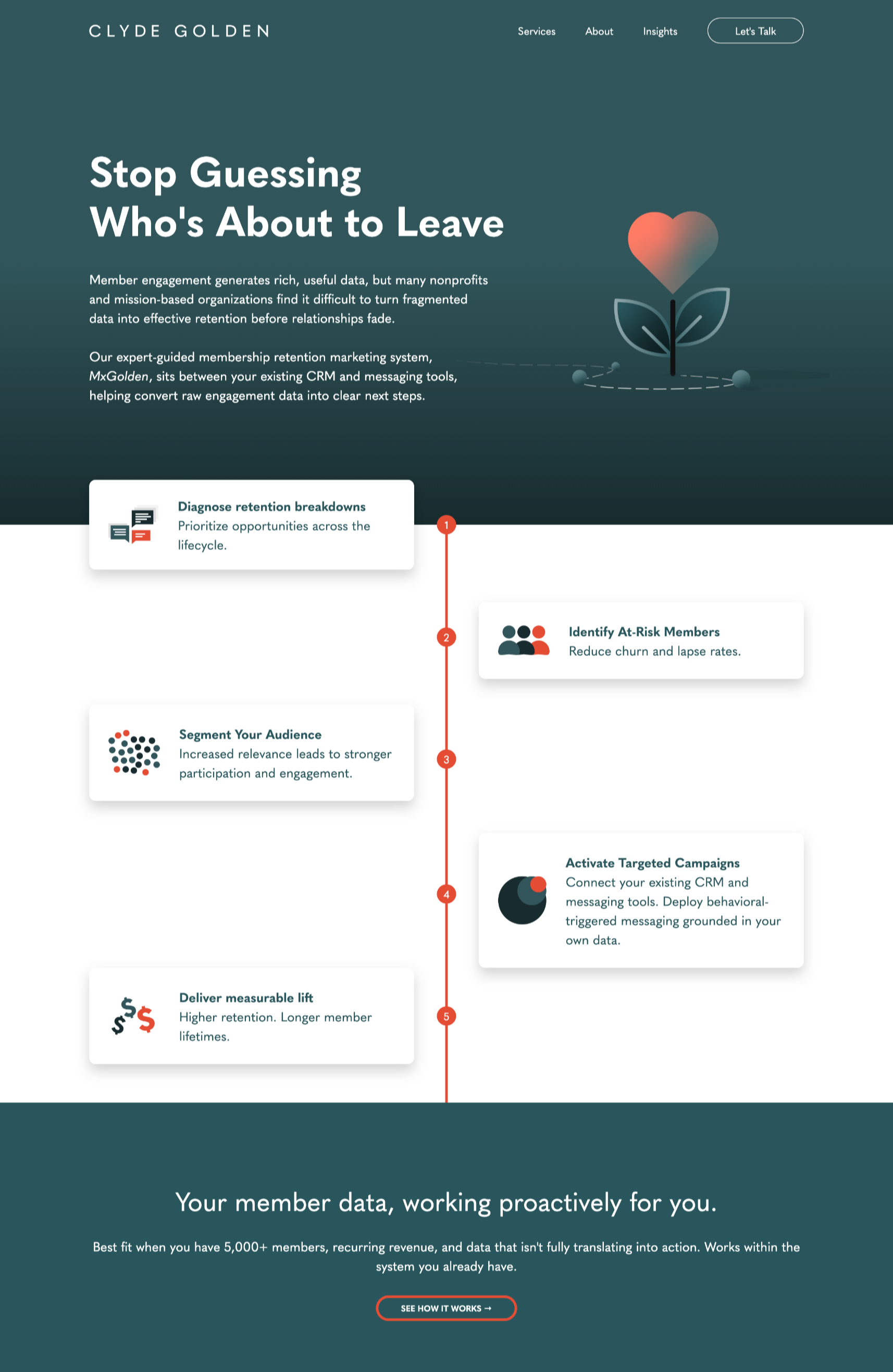
We recently updated our website to better reflect our services.
Many thanks to Jonny McConnell, Lili Joo, Matt Clifton, Michael Wilson and James Spence, each of whom played an important role in the update.
Over the past few months we've further tightened our positioning. Today, you can tell people that we're focused on Membership and donor retention for non-profit and mission-based organizations.
Additionally, this year, Matt Clifton and I have soft-launched MXGolden, an expert-guided membership retention system. A key component of the system is our proprietary software that sits between your existing CRM and messaging tools, turning raw engagement data into clear next steps.
In practice, that means MxGolden can help answer questions like:
We're really excited about it. You can read more about MxGolden and our membership retention marketing system on the website.
MXGolden is a service offering of Clyde Golden, the member retention marketing agency for nonprofits and mission-based organizations.
Anacortes, WA
