
What if the donors you seek are already here?
If you run a nonprofit or a mission-based for-profit organization, it's worth thinking about who might already have loyalty to you when you're looking for new donors.
Read More
September 9, 2026
Report

By Tim Yeadon, Principal
“I don't know, but I bet there's research on it”
I know this because, a few times a year, I upload transcripts from my AI note-taker into an LLM and ask, "What are some things I say over and over?"
The things we do over and over define us. Habits. Good or bad. I learn a lot by doing this analysis of my Zoom calls. It’s been a surprisingly simple, effective way to improve how I communicate.
The robot usually gives me a cringe-worthy rundown of my verbal tics. For instance, I almost always slowly say, “ahhh, let’s see here,” when I open up a document during a Zoom call. That’s just me hiding my nerves.
I've also asked whether it can identify my propensity for digressions during presentations. This is when I wander off into what I think is a fun story that realistically has zero to do with what we're working on. Again, I've improved and do this less, but it's hard to say whether I'll ever completely lose this habit. (At least I enjoy the stories, and I'm having a good time. And isn't that what matters most? Haha.)
I’ve also been given a list of topics that I’ve discussed the most with clients: reducing churn, onboarding, platform annoyances, segmentation, API connections (and Zaps, so many Zaps), followed by “your kids,” “my dog Maeby,” “your vacation,” and “I’d like to go sailing.”
Also, according to the robot, I often say, “I don't know, but I bet there's research on it.” Sometimes I say it just a little bit dismissively. Sometimes optimistically.
I said that just last week to a marketing manager at a food co-op. We were talking about onboarding new member-owners. Neither of us really knew how long the average food co-op member's first burst of enthusiasm lasted. A week? A month? Half a year?
After the call, I went and checked.
I already knew that multiple retention studies across SaaS, membership organizations, and subscription businesses highlight the first 90 days as the critical window. Engage a new member during that window, and they're less likely to wander off.
But specific to food co-ops? I didn't find a definitive answer. And that's fine. The real number was never going to be sitting in someone else's study. General research is a cheap, fast way to calibrate your expectations before you've looked at anything of your own. It tells you if you're in the right neighborhood, but it doesn't tell you the address. The address is sitting in your own system right now.
My experience suggests you probably have about 30 days to get someone to take at least one meaningful action (shop at the co-op, attend an event, or use a coupon). That's a good place to start. All of these are measurable. With the data you have today, you can find out how many new member-owners are doing one of these things.
As an aside, I found a solid piece of advice from Principle 6, a global network of cooperatives, recommending that you check in with new member-owners somewhere in the 90-to-120-day window to survey them on whether the mission and benefits were clear, whether they've connected with staff or participated in events, and what's getting in the way. Anyone with an onboarding program of any type would be smart to survey new members to see what they actually say.
None of this replaces knowing your own numbers. Marketing is full of confident guesses, but it's probably better to start with evidence from your own data. A baseline from which to improve incrementally.
It’s the same methodology I’m using with my ongoing analysis of my Zoom calls. All I can do is review the evidence, face the facts, and find new ways to improve. How long will it take? Should I be trying new methods? I don't know, but I bet there's research on it.
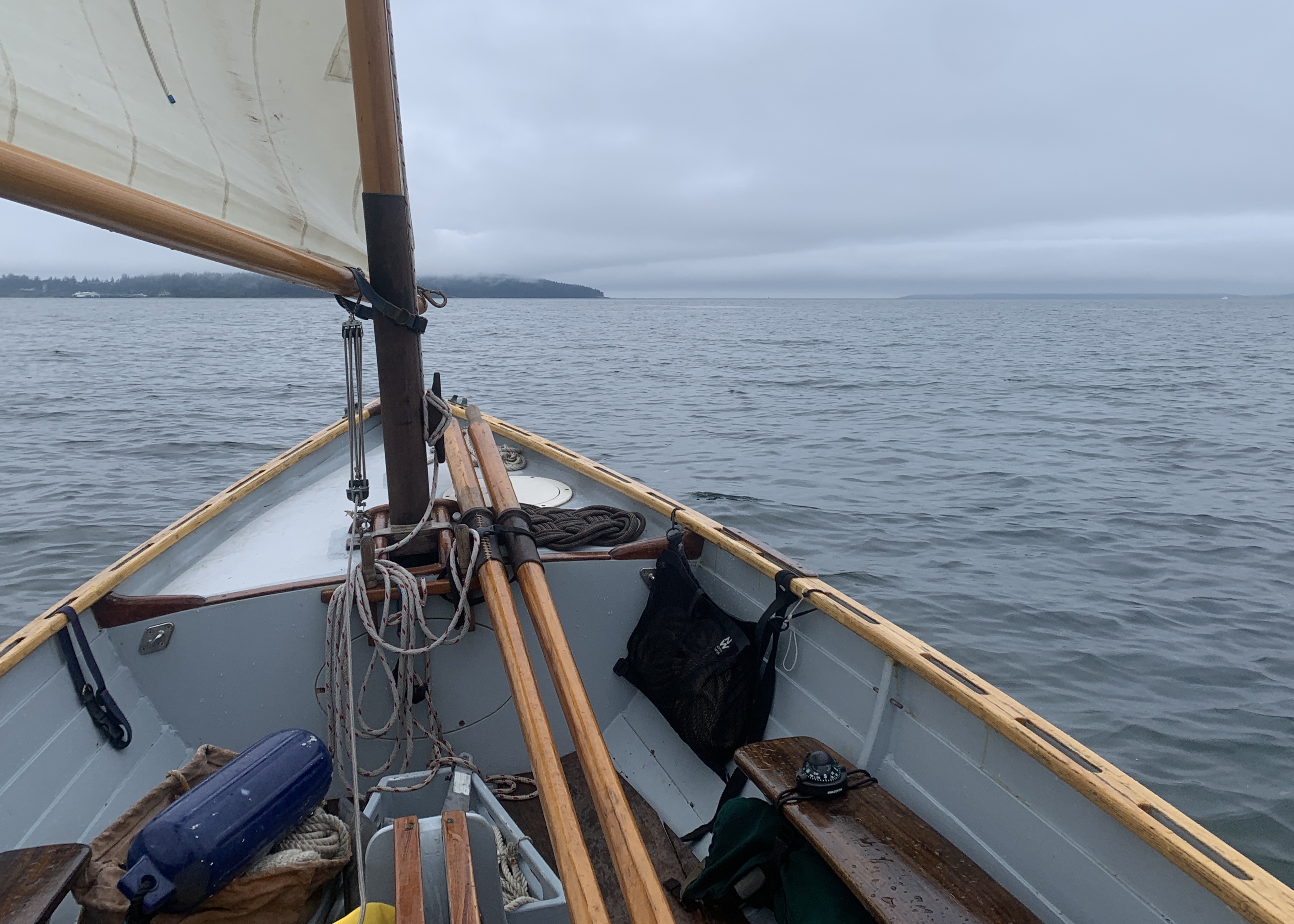
My desk overlooks this stretch of Guemes Channel. Ahead are Washington Park and Rosario Strait. Lopez Island is in the distance.
I had a chance to get out sailing and camping for a few days earlier this month. Say what you want, but I'm pretty sure grey is the most relaxing color.
Here’s a brief summary of the ways we can help. Or hit reply and say hi. We’d love to hear what you're up to these days.
MXGolden is a service offering of Clyde Golden, the member retention marketing agency for nonprofits and mission-based organizations.
Anacortes, WA

